

By Lynn Chapman, PGN STE(A)M Lead
Last week, I attended the Flood and Coast conference in Telford, representing Project Groundwater Northumbria (PGN) which is part of the Flood and Coastal Resilience Innovation Programme (FCRIP) and the Flood and Coastal Innovation Programme (FCIP).

The team and I had a great time learning about what was happening all over the country and this was also a great opportunity to network. The conference was split into different areas, which included an auditorium with guest speakers, several workshops and the exhibition stands.
Calls to Action: Allyship with Nature
During the conference, I had several eye-opening moments.
Beccy Speight, from the Royal Society for the Protection of Birds (RSPB), delivered an impactful opening speech.
The Royal Society for the Protection of Birds (RSPB)
She highlighted the decline in bird populations (13% since 1985) and the loss of 50% of salt marshes since World War II. These losses are attributed to climate change, agricultural practices, and coastal squeeze.
Beccy emphasized the urgency of the situation and challenged us to take action. Despite the damage, there’s hope for recovery if we act swiftly and at scale.
Dr. Anusha Shah, President of the Institution of Civil Engineers (ICE), delivered an impactful address opening. Her perspective considered both flooding and drought challenges. Here are some key takeaways from her speech:
- Holistic Water Cycle: Dr. Shah emphasized the need to consider the entire water cycle and restoring balance and harmony across ecosystems.
- Nature as Our Ally: She passionately advocated for restoring and reviving nature. In the face of the climate emergency, nature can be our greatest ally.
- Mainstreaming Pilot Studies: She wants pilot studies—innovative, practical solutions—to become mainstream.
- From my perspective, nature-based solutions offer benefits beyond flood control and habitat creation—they uplift communities and bring value to previously overlooked areas.
Unlocking Effective Collaboration
I participated in a captivating workshop centered around collaboration. The game aimed to create a framework—a toolkit—for better problem-solving and teamwork.
Here’s how it worked:
- Unique Communication Styles: Each player received a personality type (shy, loud, confrontational, etc.). Understanding our distinct communication styles was key to success.
- Advocacy Roles: We were assigned roles, for example Lead Local Flood Authority, Community Action Group, Developer, and more. Our task? Advocate passionately for our assigned positions.
Here’s how it unfolded:
- My Personality Type: I was assigned the role of “wouldn’t speak in groups.” Quite the opposite of my natural self! Keeping quiet was a delightful challenge. 😊
- Advocating for Community Groups: Representing community groups.
- Our mission: To advocate for creating open spaces. These spaces would combat high summer temperatures, poor air quality, and water issues.
- The Scenarios: Around the table, we presented various scenarios to champion our cause. Some carried more weight than others. When needed, I teamed up with other roles to maximize our impact.
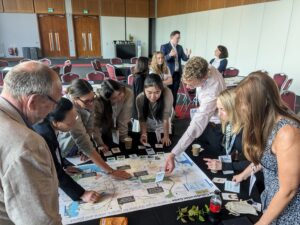
The objective of the game was to score as many points as possible but this wasn’t revealed until we had settled on the number of scenarios and although we did score very highly we weren’t the highest in the room on the day!
The game was a delightful blend of strategy, negotiation, and creativity. By embracing our roles and understanding one another, we honed our collaborative skills.
Shared Learning
The conference was a great opportunity to learn from other projects, meet new people and engage in different workshops. My key takeaways from the conference are we need to look at the whole water cycle to find equilibrium and collaboration with all stakeholders is vital to deliver a successful project.


